

On 26 March 2020 I watched Louis Vuitton’s first livestream on Xiaohongshu from my sofa in Xuhui. It came out of the Hang Lung boutique on Nanjing West Road, ran one hour and ten minutes, and put the blogger Cheng Xiaoyue next to the actress Zhong Chuxi in front of the summer collection. Around 15,000 people watched it in total, a number CBNData reported that July alongside the rest of the post-mortem.
The comments were merciless. A printed backdrop taped to a wall, flat lighting, a phone camera held at chest height. One viewer wrote that the picture quality was so poor she had briefly believed the brand had become affordable.
Six years on, European marketing directors still ask me the same question, usually in the same hopeful tone.
So here is my answer, and it is not the one most agencies in Shanghai will give you: livestreaming works beautifully for beauty, for jewellery under a certain price, and for authenticated resale. For a 20,000 RMB handbag or a runway coat, it does not work as a sales channel, and you should stop budgeting it as one. It can still be worth doing. Just not for the reason on your slide.
Bain’s 2025 category numbers already drew the line for you
When Bain & Company published its China luxury study on 29 January 2026, most people read the headline and stopped: the mainland personal luxury market shrank 3% to 5% in 2025. The interesting part was underneath. Beauty grew 4% to 7%. Fashion fell 5% to 8%. Leather goods fell 8% to 11%. Watches fell 14% to 17%. Jewellery was roughly flat, between 0% and minus 5%.
Look at that ranking again and you are looking at the livestream ranking, almost in order.
Live commerce rewards a product a viewer can decide about in ninety seconds, at a price she will not think about the next morning, from a seller she can verify while the stream is still running. Beauty passes all three tests. A 900 RMB gold pendant passes two. A leather goods purchase at eleven thousand fails on the second and the third, because at that price a Chinese client is not buying an object, she is buying the certainty that the object is real and that someone will look after her when something goes wrong with it.
Bain noted one more thing in the same study, and it is the detail I keep quoting to clients. In the secondhand market, which grew 15% to 20% in 2025, livestreaming has become a trusted channel for product verification. Not for desire. For proof. Somebody holds the bag up to the lens, turns the date code toward the camera, and the format finally does something the product actually needs.
What a Chinese livestream looks like at 21:40 on a weeknight

I show this screenshot in almost every first meeting, because a lot of European brand teams have never actually sat through a Chinese livestream. They have read about the GMV. They have not seen the 999 RMB threshold banner, the gift-box giveaway, the fan-club light sticks, the host at minute seven of a seven-hour shift.
The reaction is always the same small silence.
Then somebody says: that is not us. And they are right, it is not. The mistake is what usually comes next, which is deciding to do the same thing with better lighting. Better lighting does not change the grammar of the format. Discount countdowns, urgency, volume and repetition are not decoration on top of live commerce in China. They are the mechanism. Remove them and you have not made a luxury livestream, you have made a very expensive video with a chat box.
If you want the regulatory side of this, we covered the 2026 rules separately in our piece on China’s livestream e-commerce rules and I will not repeat it here.
Jewellery is where the format stops fighting the product
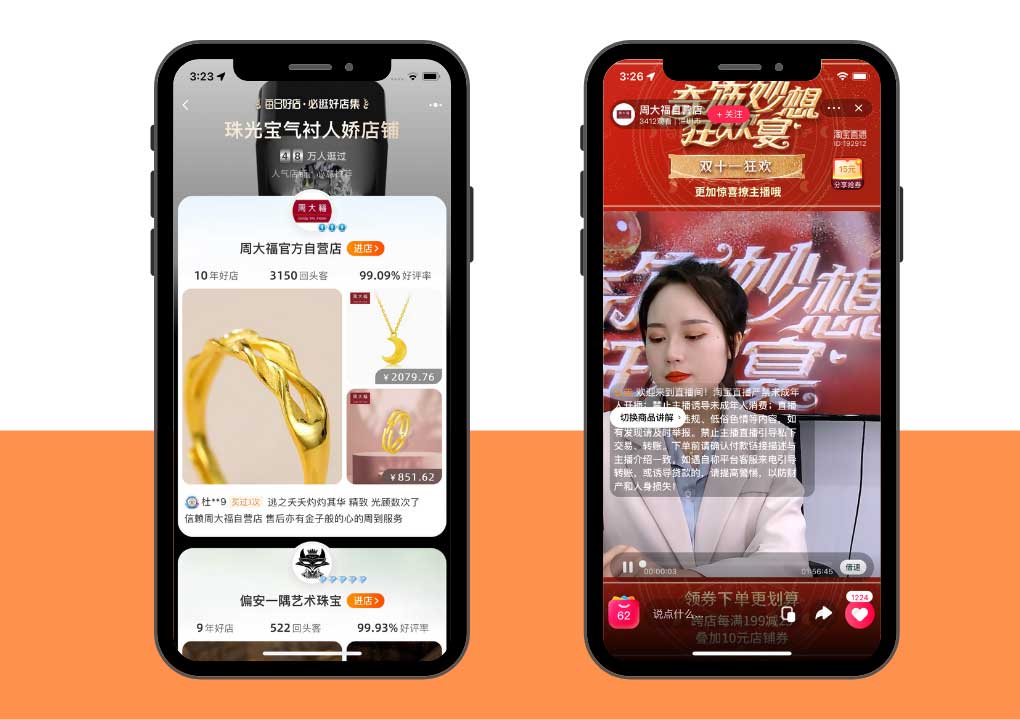
Chow Tai Fook has been doing this for years and it is not glamorous work. It is a room, a host, a tray, a price, and a shop record visible at the top of the frame.
What makes it function is that gold and small diamond pieces sit in the price band where a Chinese consumer will still buy from a screen, and where the material itself carries the guarantee. Nobody worries whether the gold is gold. The seller’s rating does the rest.
European jewellery houses in the 3,000 to 15,000 RMB band can absolutely play here, and a few quietly do. Above that, the same wall appears as in leather goods. I have never seen a Chinese client buy a watch at six figures from a livestream, and I would be suspicious of anyone who tells you they have.
The brands took the camera back, and that changed the arithmetic
The other reason this conversation feels different in 2026 is that the influencer era of Chinese live commerce is over, or at least no longer the default.
According to research published on 13 June 2026 by 晓观点, the e-commerce research desk at Xiaoduo, brand-owned streams on Douyin passed influencer-hosted streams for the first time in 2025 at 55% of GMV, and reached 62% in the first quarter of 2026, pushing influencer-led streams below 40%. The same analysis tracks top-influencer commissions falling from 30% to 35% in 2023 down to 10% to 12% in beauty and 5% to 8% in apparel by 2026.
That matters for a luxury house more than the headline GMV numbers do. It means you can now run your own room, on your own schedule, with your own script, without renting a personality whose other clients sell moisturiser at 79 RMB. Building and staffing that room is the real cost, and it is a recurring one. Anyone quoting you a one-off Douyin production as if it were a campaign has not run one.
Volume on the fashion side is genuinely there, incidentally. 新京报 reported on 4 June 2026 that during Douyin’s mid-May apparel push, from 15 to 20 May, the number of fashion brands crossing 100 million RMB in GMV doubled year on year, and store-run streams passing 10 million RMB grew 78%.
That is fashion. Not luxury. The distinction is the whole article.
A client who asked for the right thing for the wrong reason
Last year an Italian leather goods house came to us wanting a Douyin livestream, and when I asked why, the honest answer was that a competitor had one.
We agreed on a test rather than a launch. Four streams, and only small leather goods on the shelf, card holders and belts between 2,900 and 3,900 RMB. First stream sold eleven units. Second sold nine. On the third we changed the host to the brand’s own Shanghai retail trainer, who spent four minutes explaining how the edges of a card holder are painted by hand, and that stream sold in the forties.
Then the marketing director asked to put the 18,000 RMB tote in.
It sold nothing. Across three streams, zero. But six viewers asked in the comments where the Shanghai boutique was, two came in that month, and one of them bought the tote in store at full price. So the stream did work for that bag. It just worked as media, and if we had judged it on stream revenue we would have killed it as a failure.
That is the reporting change I ask every client to make before we start. Small leather goods get a sales target. Anything above roughly 10,000 RMB gets a media target: qualified viewers, boutique enquiries, WeChat adds. Two different lines in the deck. Two different definitions of a good night.
Where the money should actually go first
If your budget for China this year is modest, I would not start with live at all. I would start with the thing that decides whether anyone watches your stream in the first place, which is whether your brand already means something on Xiaohongshu and Douyin before you go on air. An empty room is an empty room in any language.
The Chinese houses understand this. When 华丽志 compiled its luxury brand activity index for the first half of 2026, covering 249 recorded moves by 74 luxury brands between 1 January and 30 June, live was one channel among ten, sitting alongside store openings, exhibitions and campaign launches. It was not the strategy. It was one instrument in the strategy.
Do it in that order and live streaming becomes a reasonable line item. Do it in reverse and you will spend a year producing well-lit television for eleven people.
My own rule, after fifteen years of watching brands try: if the product needs a boutique to be sold, the livestream is there to fill the boutique, not to replace it. Judge it that way and the answer to the title is yes. Judge it on stream GMV for a four-figure euro handbag and the answer is no, and no amount of production budget will change it.
If you want a second opinion on whether your category sits on the right side of that line, our luxury team in Shanghai looks at this most weeks and will tell you when the answer is no.
Cindy Zhang is CEO of Fashion China Agency. She was chief editorial and PR officer at Vogue China, worked brand-side at Guerlain, and led the luxury segment at Xiaohongshu.