

In 2026, Kering will close at least 100 stores. Not as an emergency measure. As a plan, described by its own CEO as the healthy version of the group’s future in China.
I spent years at Vogue China watching brands treat a new flagship the way a new hire treats a business card: Nanjing Road, then Chengdu, then a third floor added to the Chengdu store because the second one filled up. That era is closing, literally. I have walked past shuttered mall units that used to carry a maison’s name on the glass, and I have watched the same brand’s sales climb on a phone screen the same week.
This piece is about that gap. Why physical luxury retail is shrinking across China in 2026, why ecommerce and content commerce keep growing through the same period, which brands are managing the shift well, which are not, and what a European or international fashion or luxury brand should actually do about its own store plan this year. This is not a blip tied to one bad quarter. It is a structural change in how brands reach Chinese consumers, and the numbers below are why I am confident saying so.
- 100+ stores. Kering’s planned net store closures in China for 2026, part of a group strategy shift toward “brand desire” over network size (Huxiu, June 8, 2026, citing Kering CEO Luca de Meo).
- 17,100 stores. Retail locations across mainland China, all formats, that announced closure in the first half of 2026 (Huxiu, 2026, national retail data).
- EUR 38.6 billion. LVMH’s group revenue for H1 2026, down 3% year on year, with net profit at EUR 5.7 billion (LVMH H1 2026 interim results, reported June 2026).
- 4,600 stores. Hypermarkets closed nationwide in 2025, the single hardest-hit retail format (Huxiu, 2026, citing national retail data).
- +10%. Burberry’s Greater China same-store sales growth in its FY2026 fourth quarter, against the wider contraction (Huxiu, June 8, 2026, citing Burberry CEO Joshua Schulman).
The Questions Brands Actually Ask Me About China Retail
I get some version of the same six questions on almost every call with a brand rethinking its China footprint. I am answering all of them in this article, but here is where to find each one.
Should I close my flagship?
Not necessarily, and not everywhere. See the brand-by-brand benchmark below: the answer depends on your category and your city.
Is ecommerce actually replacing the brand experience a store gives?
Partly, and the data on where consumption actually moved answers this directly further down.
Which cities still deserve physical investment?
A short list, and Ralph Lauren already answered it publicly. See the benchmark section.
If I keep a store, what do I keep it for?
Burberry’s answer, narrower and more specific than “everything,” is in the benchmark section too.
Does closing stores mean walking away from China?
No. It means moving budget. The solutions section shows where that budget goes and how the mechanism actually works.
How fast is this happening, and is it luxury-specific?
It is faster and broader than luxury. The market trends section below gives the timeline and shows this is a retail-wide shift, with luxury as one part of it.
What Changed in China’s Retail Market in 2026
Store closures are running at national scale, not just in luxury
At least 17,100 stores across mainland China announced closure in the first half of 2026, across hypermarkets, department stores, specialty stores and branded stores (Huxiu, 2026). This is broader than fashion or luxury. It sets the backdrop against which luxury’s own closures should be read: brands are not closing stores because luxury demand collapsed, they are closing stores because a fixed, expensive retail format is losing ground everywhere in China, and luxury is not exempt.
Hypermarkets took the hardest hit, losing 4,600 stores nationally in 2025 alone (Huxiu, 2026). Overall social retail sales grew only 1.4% across January to May 2026, with May alone posting a 0.6% decline (Huxiu, 2026). Format by format, the picture is uneven.
| Retail format | Change, H1 2026 | Note | Source |
|---|---|---|---|
| Branded / flagship stores | -7.6% in sales | Steepest decline of any tracked format | Huxiu, 2026 |
| Department stores | -1.8% in sales | Huxiu, 2026 | |
| Specialty stores | -1.2% in sales | Huxiu, 2026 | |
| Hypermarkets | -4,600 stores | Store count, 2025, not a sales percentage | Huxiu, 2026 |
| National social retail sales | +1.4% | Jan-May 2026; May alone -0.6% | Huxiu, 2026 |
Global luxury groups are closing stores on purpose, not by accident
Kering plans a net closure of at least 100 stores in China in 2026. Gucci, its largest brand, has already removed several flagships from core shopping malls, including its store at Shanghai IAPM (Huxiu, June 8, 2026). Hugo Boss made a net reduction of 50 stores over the same period, with CEO Daniel Grieder framing it as trading short-term revenue for long-term profitability (Huxiu, June 8, 2026).
LVMH’s Louis Vuitton, meanwhile, closed at least four stores in China since 2025: a chocolate shop concept in Shanghai’s Qiantan Taikoo, a store inside Beijing Capital Airport, a department store location in Kunming, and a store at Chengdu Tianfu International Airport (163.com, 2026). At group level, LVMH’s H1 2026 revenue reached EUR 38.6 billion, down 3% year on year, with net profit at EUR 5.7 billion. Louis Vuitton’s own H1 2026 revenue was EUR 3.86 billion, also down 3% (163.com, 2026).
Not every brand is retreating
Burberry’s Greater China same-store sales grew 10% in its FY2026 fourth quarter, against a global same-store improvement of 5% (Huxiu, June 8, 2026). That single data point is the reason this article is not titled “luxury is leaving China.” It is leaving certain formats and certain cities. It is not leaving the country.
Who Is Winning and Losing: A Benchmark of Four Retail Strategies

Kering and Gucci: cutting network size on purpose
Kering’s plan for at least 100 net store closures in 2026 is paired with a stated strategy shift. CEO Luca de Meo put it plainly: growth will rely less on store network expansion and more on brand desire and cultural relevance (Huxiu, June 8, 2026). Gucci has already pulled flagships out of prime mall real estate, Shanghai IAPM among them. The logic: a smaller number of stores in the right locations, backed by content and scarcity, sells more per square meter than a large network spread thin. A smaller brand can copy the discipline of picking fewer, better locations. It cannot copy the scale: Kering can afford to walk from rent it no longer needs while it rebuilds desire through campaigns and product drops. A brand with three stores in China does not have that cushion, and closing badly performing locations without a content plan to replace the visibility just leaves a hole.
Hugo Boss: trading revenue for margin
A net reduction of 50 stores, explained by CEO Daniel Grieder as a deliberate sacrifice of short-term revenue for long-term profitability (Huxiu, June 8, 2026). This works when a brand has enough scale that closing a loss-making store improves the group’s numbers rather than just shrinking them. For a brand entering China or still building recognition, the same move can look identical on paper and mean something much worse: fewer stores with nothing built to replace the discovery function they were serving.
Ralph Lauren: redirecting density instead of cutting it
Ralph Lauren grew roughly 40% in China in fiscal 2026, then deliberately guided its own growth down to around 15% for the following year. CEO Patrice Louvet described the approach as playing for the next 10 to 20 years, not just the current one (Huxiu, June 8, 2026). Instead of broad expansion, the brand is concentrating density in six cities: Beijing, Shanghai, Chengdu, Shenzhen, Hong Kong and Taipei. This is the model most relevant to a mid-size international brand. You do not need one hundred cities. You need to be undeniable in five or six, and invisible nowhere that matters.
Burberry: narrowing the store’s job, not the store count
Burberry’s Greater China same-store sales grew 10% in FY2026 Q4 while the group narrowed its core assortment to outerwear and scarves, and rolled out over 200 “scarf bar” personalization experiences in stores (Huxiu, June 8, 2026). CEO Joshua Schulman tied the same-store improvement directly to rising brand desire and core category strength. The lesson: a physical store that used to carry an entire collection can survive, and grow, if you strip it down to the two or three things the brand does best and turn the visit into something a screen cannot replicate. A smaller brand can absolutely copy this: pick your one hero category, build the in-store experience around it, and stop asking one store to be everything.
Where the Money Actually Went
Closing a store does not mean the Chinese consumer stopped buying. It means she stopped buying there. Three shifts explain most of it.
- Channel. Content-commerce platforms, chiefly Xiaohongshu and Douyin, now sit ahead of the store visit in the purchase path for most premium categories. TOD’S sold out a capsule collaboration with actor Xiao Zhan within one minute of launch, generating roughly 10 million RMB (about USD 1.4 million, at 7.1 RMB per USD, September 2026) in featured handbag sales within two hours (Huxiu, 2026). No flagship produces that kind of concentrated demand in a single afternoon.
- Category. China’s own luxury market contracted about 5% in 2025, but the contraction was not even. Watches and leather goods, the most logo-visible categories, fell 14 to 17% and 8 to 11% respectively, while beauty, premium electronics and wearables grew (fashionchinaagency.com analysis, September 2026). Wealthy Chinese consumers did not stop spending. They moved the money toward categories that reward verifiable craft and performance over visible status.
- City tier. Roughly 75% of wealthy Chinese consumers live outside the tier-1 cities where most flagship stores concentrate, according to prior reporting on this site. That is the structural reason Ralph Lauren’s six-city plan and Burberry’s narrower assortment both lean on digital reach to cover the ground physical retail cannot: online and content channels serve the buyer in Hangzhou or Xiamen who is never walking past a Nanjing Road window.
For a foreign brand watching this from Paris or Milan, three lines matter more than the rest of this section. First, a closed store is not a closed market, it is a channel decision. Second, brand desire built on Xiaohongshu and Douyin now does work that a flagship used to do alone. Third, if your China plan still assumes tier-1 mall footfall as the main growth lever, it was written for a market that no longer exists in that form. For more on how Chinese luxury spending patterns shifted by category in 2025 and 2026, see our analysis of the 2026 China luxury consumer.
What To Do Instead of Opening Another Store
None of this means retreat. It means moving budget toward the channels actually carrying Chinese luxury demand in 2026. Three angles work together.
Social media: build desire before anyone reaches a till
Xiaohongshu is where most Chinese luxury purchases start their research, well before a store visit or an online order. A content program built on creator seeding, honest product detail and native Spotlight or Search ads replaces the discovery job a flagship window used to do, at a fraction of the fixed cost of a lease. Douyin adds video reach and, increasingly, its own store function, so a brand can run discovery and a direct sale on the same platform without sending the buyer anywhere else. We run exactly this kind of program through our Xiaohongshu marketing service.
Ecommerce: pick the flagship that fits your entry stage
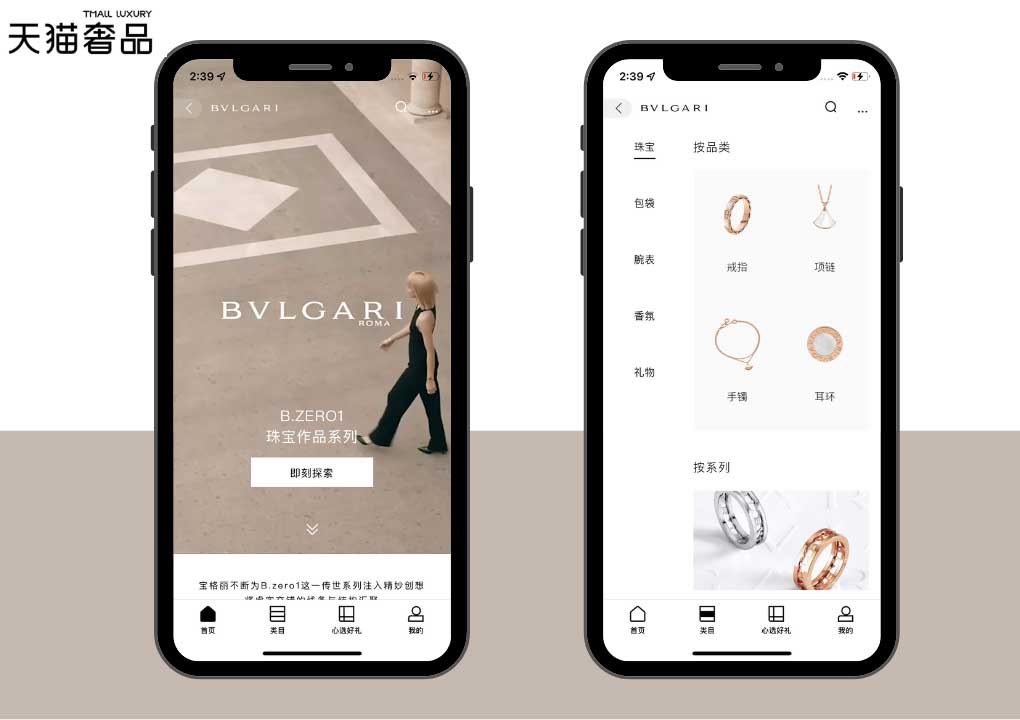
“Brand desire over expansion” has a direct ecommerce translation. A brand not ready for a Chinese entity can open on Tmall Global as a cross-border flagship, keeping pricing control without local registration. A brand with real local demand can graduate to a domestic Tmall flagship, or add a Douyin store for content-driven, impulse-friendly sales. Each path carries a different deposit and licensing burden, and the choice should follow your actual China maturity, not your headquarters’ comfort level. Our ecommerce agency service maps that path against your specific product category.
Digital marketing: replace what the closed store used to carry
A physical store did more than sell. It held the relationship: the sales associate who remembered a client’s size, the after-sales visit, the invitation to a trunk show. A WeChat private domain program, built around an official account, VIP tiers and a mini program store, is the direct replacement for that relationship once the store is gone. Mini program stores are converting at 8 to 12% for fashion brands in 2026, well above a typical open ecommerce listing. Layered on top of that, visibility on Chinese AI assistants such as DeepSeek, Doubao and Baidu’s own AI answers is becoming a real discovery channel in its own right, and it rewards brands with clear, structured, factual content rather than a heritage story alone. We build both sides of this through our WeChat agency service and our GEO service for China.
Sources
Four external reports underpin the figures in this article, each checked against the original outlet rather than a secondhand summary.
- Huxiu, “H1 2026 social retail sales report” (2026): the 17,100 store closures, the 4,600 hypermarket closures in 2025, and the format-by-format sales declines used throughout this article.
- Huxiu, “The 2026 luxury CEO consensus on brand desire” (June 8, 2026): the Kering, Hugo Boss, Ralph Lauren and Burberry executive statements and store actions in the benchmark section.
- Huxiu, “Luxury moves from price hikes to refined China operations” (2026): supporting detail on category-level performance and store network adjustments across groups.
- 163.com (NetEase), “Louis Vuitton store closures across China” (2026): the four specific Louis Vuitton closures and LVMH’s H1 2026 financial results.
For the ecommerce side of this shift in more detail, see our earlier piece on why ecommerce is essential for luxury brands in China.
About the Author
I am Cindy Zhang, CEO of Fashion China Agency. I spent years as chief editorial and PR officer at Vogue China deciding how European luxury brands got translated for Chinese readers, then moved brand-side at Guerlain, then ran the luxury segment at Xiaohongshu, watching from inside the platform how Chinese buyers actually research before they walk into, or skip, a store.
How Fashion China Agency Can Help, and One Brand We Worked With
We help fashion and luxury brands rebuild the parts of their China presence that a closed store used to carry: content that creates desire before a purchase, the right ecommerce flagship for their entry stage, and a private domain program that keeps a client after the first sale. If your brand is rethinking its store count this year, talk to us before you sign or cancel another lease.

One case that stayed with me: a family-owned French leather goods house we advise ran two mall stores, in Chengdu and Wuhan, through 2025. Foot traffic fell every quarter while rent did not move. In January 2026 they closed both and kept a single flagship in Shanghai. The freed budget went into a WeChat private domain program and Xiaohongshu seeding. By August 2026, the brand’s private domain list had passed 3,000 members, and its mini program repeat purchase rate reached 22%, higher than either mall store had ever produced in its final year of operation. This is not an official case study with the client’s name attached. It is the pattern I now see often enough to trust it.